Transnational Networks on the Criminalization and Legalization of Abortion in Latin America
PhD Dissertation: Reproductive Rights in Latin America: Transnational Activism and the Evolution of Abortion Legalization and Criminalization Policies in Argentina and Brazil (2010-2022)
Advisor: Mónica Salomón (UFSC)
Committee: Catherine D’Ignazio (MIT), Debora Lopreite (UBA), Iara Leite (UFSC), Cecilia Sardenberg (UFBA)
Abstract: My PhD dissertation analyzes how transnational feminist and anti-feminist movements promoted the diffusion and internalization of international norms regarding reproductive rights in Brazil and Argentina between 2010 and 2022. The central research question is: “How did transnational feminist and anti-feminist activisms promote and internalize international norms on the legalization and criminalization of abortion in Brazil and Argentina?” The objectives of the dissertation include: (1) identifying the actions, strategies, and methods of transnational feminist and anti-feminist activisms in Brazil and Argentina, historically situating their actions; (2) theoretically analyzing the actions of these activisms in multilateral forums related to gender and their relationship with the foreign policy of both countries; (3) understanding how these transnational activisms demand, use, refuse, and produce data for their political goals. The developed argument is that the feminist movement of the Green Tide, which emerged in Argentina but operated transnationally, managed to articulate and disseminate the norm of abortion legalization regionally without relying on the structures of the global North, challenging classical theories of norm diffusion that emphasize the dependence of transnational networks on the global North. On the other hand, transnational anti-abortion movements in Brazil and Argentina used counter-framing strategies, despite not having formal involvement in regional international organizations. Furthermore, the demand, use, refusal, or production of data by transnational feminist activism varied according to the need for capital and human resources. Sometimes, local organizations prioritized internal data activism, using transnational data activism as a complementary resource. In contrast, anti-abortion activists used counter- framing strategies, employing the international language of human rights to oppose the data production efforts of pro-reproductive rights groups. The methodology combines interviews with 17 activists from transnational organizations and social movements, a document analysis of 770 multilateral forum documents (249 of which refer to reproductive rights), and a discourse analysis of material published by anti-abortion groups on their social media.
Related publications:
Jungs de Almeida, Alessandra. Reproductive rights in Latin America: transnational activism and the evolution of abortion legalization and criminalization policies in Argentina and Brazil (2010-2022). Dissertation (PhD in International Relations). Graduate Program in International Relations, UFSC. Florianópolis, p. 278, 2024.
Jungs de Almeida, A.; Austria, R.; Ferretto, Martina. September 28th in Latin America and the Caribbean: The date that unites us in the struggle for abortion rights. In Portuguese at Catarinas, in English at Feminist Perspectives – King’s College, and in Spanish at La Costilla Rota. 2024.
Data activism about feminicide across the Americas
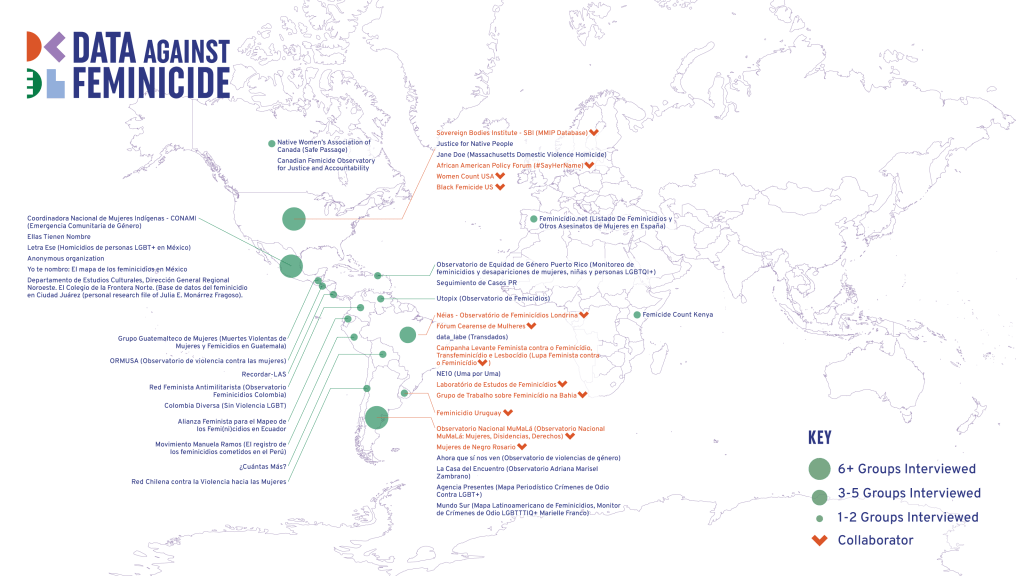
As a research affiliate at the Data + Feminism Lab at MIT, I collaborate with the participatory action research project “Data Against Feminicide,” which aims to (1) understand the data-gathering practices and technological challenges faced by activists who monitor feminicides and other forms of gender-related violence, particularly in the Americas, and (2) work with activists to co-design and develop digital tools that facilitate their monitoring labor. Through this work, our team has co-developed a data highlighter browser extension and an email alert system that uses machine learning to identify news articles that are highly likely to concern a feminicide. Both tools are freely accessible in English, Spanish, and Portuguese. Supporting materials and tutorials can be accessed here.
I contribute to the project’s qualitative research and collaborative work with activists, including coordinating our work in Brazil alongside Isadora Cruxên.
Publications related to the project that I led or contributed to:
- Jungs de Almeida, Alessandra (ed.). 2025. Estudios Feministas de Seguridad desde América Latina y el Caribe. Florianópolis: UFSC.
- Jungs de Almeida, Alessandra, Lauren Klein, e Catherine D’Ignazio. 2024. “Missing Data.” Em Keywords of the Datafied State, editado por R. Singh, J. Burrell, e P. Davison. Data & Society.
- Jungs de Almeida, Alessandra. 2022. “‘Contando Feminicídio’: Um Glossário Feminista para Ativistas de Dados.” Data + Feminism Lab, MIT, 23 de novembro.
- Jungs de Almeida, Alessandra, Isadora Cruxên, Radhika Radhakrishnan, e Catherine D’Ignazio. Challenging (in)security: Missing Data and Counterdata Production on Feminicides in the Americas. Em Priscyll Anctil, “Feminist Security Studies in the Americas: Pushing the Fronteras.” Capítulo de livro, forthcoming, Palgrave Macmillan in the “Global Security” series.
- Cruxên, Isadora, Alessandra Jungs de Almeida, e Catherine D’Ignazio. 2023. “Data Activism Against Feminicide: Co-Designing Digital Tools to Monitor Gender-Related Violence Across the Americas.” School of Business and Management – Queen Mary University of London.
- Cruxên, Isadora, Alessandra Jungs de Almeida, Lauren F. Klein, e Catherine D’Ignazio. 2024. “Dados Ausentes e Contradados.” Em Informe Feminicídios Brasil 2023: Monitor de Feminicídios no Brasil, editado por Silvana Mariano. Londrina: Editora dos Autores.
Leadership: Isadora Cruxên, Catherine D’Ignazio, Silvana Fumega, and Helena Suárez Val / Feminicidio Uruguay.
Partners: Rahul Bhargava, MediaCloud, The Latin American Initiative for Open Data (ILDA), Jimena Acosta, Red Interamericana Anti-femicidio
Collaborators: Feminicidio Uruguay, Sovereign Bodies Institute – SBI, African American Policy Forum, Women Count USA, Black Femicide US, Observatorio Nacional MuMaLá, Mujeres de Negro Rosario, Néias – Observatório de Feminicídios Londrina, Fórum Cearense de Mulheres – FCM, Lupa Feminista contra o Feminicídio – Coletivo Feminino Plural, Laboratório de Estudos de Feminicídios – LESFEM, Grupo de Trabalho sobre Feminicídio na Bahia – GT FEM.
 Alessandra Jungs de Almeida